

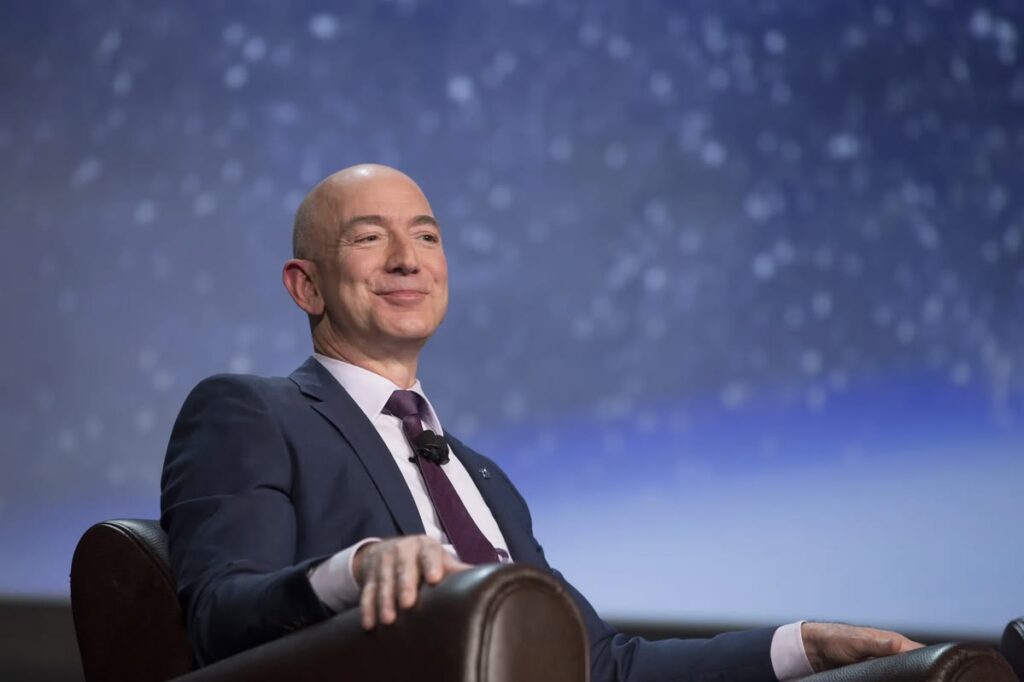
Jeff Bezos was not born into the world of entrepreneurship that would later define his public image. Before building one of the most influential companies in modern history, he was a highly successful executive working in finance. In 1994, Jeff Bezos was a senior vice president at a hedge fund in New York. He was 30 years old, well-compensated, and on a clearly defined path. His career at the investment firm D. E. Shaw offered stability, prestige, and enormous financial potential. Most people in his position would have considered it the ideal professional future. Yet Bezos became increasingly fascinated by one emerging technology that seemed capable of changing the world: the internet.
At the time, internet usage was growing at an astonishing rate. Bezos came across statistics showing annual web growth of more than 2,000 percent, and he immediately recognized that such expansion represented a once-in-a-generation opportunity. Instead of viewing the internet as a niche communication tool, he saw it as a foundation for entirely new industries. The more he studied it, the more convinced he became that commerce would eventually move online. But understanding the opportunity and acting on it were two very different things. Leaving behind a secure and highly paid career to enter an uncertain technological frontier seemed irrational to many people around him.
He walked away from it to sell books online from a garage in Bellevue, Washington. The decision was not impulsive. Bezos approached it analytically, using a philosophy that would later become famous in entrepreneurial circles. The decision was made through what he later called a regret minimization framework. He asked himself which choice he would regret more at 80: trying and failing, or never trying at all. The answer pointed west. That simple but powerful framework became one of the defining principles of his life. Rather than optimizing only for short-term security, Bezos focused on avoiding long-term regret. He believed failure would be easier to accept than the permanent uncertainty of never attempting something meaningful.
After moving to Washington with his wife MacKenzie, Bezos began building what would become Amazon. He chose books as the company’s starting point because they were relatively easy to catalogue and ship, and because the global selection of books was far too large for any physical bookstore to stock completely. The internet allowed him to offer something impossible in traditional retail: near-unlimited inventory.
Amazon went live in July 1995. Within 30 days, it had sold books to customers in 45 countries. Bezos had not anticipated international demand that quickly. The rapid growth validated his belief that online commerce could become a massive global industry. Yet the early company remained extremely small and resource-constrained. He and his early employees packed orders by hand on the floor of the garage, and he suggested they buy knee pads to ease the work. An employee suggested they buy packing tables instead. Bezos later described this as one of the most obvious things he had failed to think of. The story became symbolic of Amazon’s early culture: intense work ethic combined with constant experimentation and problem-solving.
The company went public in 1997. Many observers questioned whether the business could survive long term. Internet companies were emerging rapidly during the late 1990s, and skepticism about profitability surrounded the entire technology sector. In its first letter to shareholders, Bezos outlined the philosophy that would define everything that followed: relentless focus on the customer, willingness to be misunderstood for long periods of time, and the consistent prioritization of long-term thinking over quarterly results. That shareholder letter eventually became one of the most studied corporate documents in business history because it captured the mindset that drove Amazon’s expansion for decades.
Amazon lost money for years. Wall Street analysts regularly questioned the model. Critics argued that the company was growing too aggressively without producing sustainable profits. Many believed Bezos was sacrificing financial discipline in pursuit of unrealistic ambitions. Bezos was indifferent to the criticism in a way that proved either disciplined or fortunate, depending on when you were watching. Rather than responding to short-term market pressure, he continued investing heavily in infrastructure, logistics, technology, and customer experience. He believed that dominating long-term market position mattered more than temporary profitability.
This willingness to endure criticism became one of Bezos’s defining leadership traits. He often explained that innovation requires accepting misunderstanding because genuinely new ideas usually appear unreasonable at first. Amazon repeatedly entered industries where experts doubted its chances of success, yet the company continued expanding beyond online bookselling into entirely new sectors.
The company eventually expanded into electronics, cloud computing, original entertainment, pharmacy, and grocery. Each expansion reflected Bezos’s belief that Amazon should become an ecosystem rather than simply a retailer. The launch of Amazon Web Services in 2006 proved especially transformative. AWS, launched in 2006, became the backbone of the modern internet. By renting computing infrastructure to businesses, startups, and governments, AWS fundamentally changed how software companies operated. Many of the world’s largest digital platforms eventually depended on Amazon’s cloud services, turning AWS into one of the most profitable divisions in the company’s history.
The Amazon Kindle redefined publishing. Bezos believed books themselves would eventually become digital, even though Amazon’s original success had been built on physical book sales. The Kindle changed reading habits around the world and disrupted the publishing industry in ways few traditional publishers expected. Similarly, Amazon Prime changed consumer expectations around delivery in ways that reshaped the entire logistics industry. Fast shipping evolved from a premium service into a standard expectation largely because of Prime’s success.
As Amazon grew, Bezos became one of the most recognizable business leaders in the world. His leadership style, however, remained controversial. Admirers viewed him as visionary, disciplined, and relentlessly customer-focused. Critics argued that Amazon’s culture could be excessively demanding and aggressive. Yet even critics acknowledged the extraordinary scale of what he had built from a garage startup into one of the world’s most valuable companies.
Bezos stepped down as CEO in 2021, handing the role to Andy Jassy. Jassy had previously led AWS and was widely viewed as one of the executives most responsible for Amazon’s technological success. Bezos transitioned into the role of executive chairman while focusing more heavily on other ventures and long-term projects.
He has since focused on Blue Origin, his aerospace venture, and the Bezos Earth Fund, a 10-billion-dollar commitment to climate solutions. His interest in space exploration reflects a lifelong fascination with science fiction and humanity’s long-term future beyond Earth. He has also acquired The Washington Post and made significant philanthropic commitments, though his approach to giving has drawn more scrutiny than praise from some quarters. Unlike some billionaires who embraced public philanthropy earlier in their careers, Bezos faced criticism for waiting years before making large-scale charitable commitments.
The consistent thread through his career is a tolerance for very long time horizons. Most of what Amazon became was not visible or predictable in its first decade. The company simply stayed in the game long enough for compounding to work. Bezos consistently prioritized patience over immediate rewards, building systems and infrastructure that often appeared excessive in the short term but became extraordinarily valuable over time. His career demonstrates how long-term thinking, combined with relentless execution and willingness to endure criticism, can reshape industries on a global scale.